
The geopolitical rationale for European financial integration
European capital markets and banking reform has slowed down since the 1990s, despite significant potential benefits. A more hostile international environment has given governments a new reason to complete it, yet it remains unclear whether EU countries can agree on how to use the opportunity.
Abstract: The European Union faces two major geopolitical imperatives. The first is to insulate the European economy from rivals who manipulate access to resources, energy, or foundational technologies in order to exercise political leverage, while preventing competitors from using non-market policy instruments to undermine the profitability, or viability, of European firms. The second is to develop the capacity to act strategically in promoting European innovation, reinforcing European security, and building essential partnerships. Meeting these imperatives will require significant resources, which Europe possesses: gross savings are estimated at €33 trillion, and the Union is expected to generate €347 billion in net lending to the rest of the world in 2026. These funds, however, are routinely invested abroad rather than matched with opportunities within Europe, which is reflected in persistent current account surpluses. A savings and investment union would address part of this mismatch by using European savings more efficiently and by widening the financial resources available to policymakers for shaping investment. Completing it may appear complicated and politically contentious, but the alternatives are less viable.
Introduction
The ambition to create a European Savings and Investment Union emerged as an extension of existing plans to make European capital markets more efficient (capital markets union) and to make European financial markets more stable (banking union). Those plans had been around in one form or another — usually as a wish list of institutional reforms or collective endeavours — at least since the 1990s. Enrico Letta repackaged them as a single project in his 2024 paper for the European Council on the single market. Letta’s goal was to accelerate the green and digital transition by mobilising European savings to finance much-needed European investments (Letta, 2024: 28-38).
This idea of gathering low-hanging fruit was instantly attractive. Mario Draghi extended that goal in a later paper for the European Commission to include investment in productivity growth and the expansion of Europe’s defence industrial sector (Draghi, 2024: 59-62). In a third paper, Sauli Niinistö added investment in "readiness" and a whole-of-society approach to security and resilience into the mix (Niinistö, 2024: 163). And Andrius Kubilius put the savings and investment union at the heart of the European Commission’s White Paper for European Defence – Readiness 2030 (European Commission, 2025: 17).
For seasoned observers of European capital market and banking regulation, this broadening of a decades-old financial markets reform agenda is easy to understand but hard to take seriously. The creation of a true European savings and investment union would bring important advantages. But the same observers also recognise the strength of political resistance at the national and regional levels to the kinds of changes that would be demanded.
Lumping together the reforms required for capital markets union and banking union — while essential — does not make the work any easier (Underhill and Jones, 2023). If anything, it only adds complexity to the inertia that has prevented significant progress on either side of the agenda beyond those things — like the Single Supervisory Mechanism or the European Stability Mechanism — that came together in moments of real crisis. Even those big institutional changes have not been as transformative as might have been imagined.
Nevertheless, there is reason to believe this moment may be different. The pressure comes not from the attractiveness of greater efficiency in European capital markets or greater stability in the European banking system. It also does not come from the chimera of using public funds to mobilise private savings to finance investments in green or digital technologies, productive innovation, infrastructure, social cohesion, or a broader European defence industrial base. Instead, the pressure comes from a changing international economic and security environment.
Whether or not they recognise it, Europeans need greater insulation from global market forces and from the manipulation of their dependence on other economies for access to resources, technology, and the infrastructure for global commerce. Europeans also need a greater capacity — or, perhaps better, ”agency”, which is the capacity to act with purpose — to foster productive innovation, to identify and work with like-minded partners, and to protect their vital interests.
This combination of insulation and agency is necessary to respond to global challenges. Addressing these concerns will be expensive. Finding a way to lower that cost — and to use financial resources more efficiently — is not just something that would be nice to have. It is imperative. The challenge is to raise public awareness both about the urgency of the need and the lack of other more viable alternatives. Even a telegraphic presentation is enough to underscore the case for action.
Insulation
The European economy is built for openness. European firms trade extensively both across Europe and with other parts of the world. They invest in global subsidiaries, structural partnerships, and foreign capital markets. They draw upon raw materials, energy resources, and technology developed abroad. And they work through shared market infrastructures for goods, communication, finance, and data.
This openness is by design, not accident (Jones, 2024). The international economy created at the end of the Second World War was integrated in this way to strengthen the alliance between the United States and Europe. Together, Europe and the United States spread that pattern of integration after the Cold War ended to build a new global economy with the Atlantic economy (or the ”West”) at the centre.
The model for globalisation they fostered created significant advantages for Western companies through the elaboration of a complex division of labour based on long and interconnected global value chains. It also created important vulnerabilities. European industries, like the German automotive sector, relied on access to markets in the United States and China. Whole European economies, like Germany but also Italy and the Netherlands, depended on running consistent current account surpluses. European pension funds or other large institutional investors relied on an international diversification of assets. In turn they relied on foreign currency — typically the United States (U.S.) dollar or dollar-denominated assets — to meet their liquidity requirements (Jones, 2021).
These vulnerabilities extend far beyond trade and payments. Within the complex division of labour, Europeans became dependent upon access to raw materials and energy resources as well as on access to the technologies for putting everything together. They also became dependent upon access to the physical, digital, and financial infrastructures that connected global markets. As a result, the profitability of European business models depended implicitly on choices made in other countries about price as well as quality. It depended on control over intellectual property rights. And it depended on the determination or ability of other countries to extract rents or impose costs by exercising their leverage over chokepoints.
This collection of vulnerabilities explains why Europeans have devoted so much attention to the preservation of a rules-based international system governed through effective multilateral institutions. The European economic model depends on a mix of predictability (in terms of contracting and access) and dispute resolution (in the face of disagreements) to avoid disruption in their global value chains and cross-border investments. When actors start breaking the rules or undermining multilateral arrangements, however, those vulnerabilities become important (Bauerle Danzman and Meunier, 2024).
The America-first trade policies pursued by both the first and the second Trump administrations challenged Europeans’ access to American markets; they also challenged European openness to other countries. The industrial policies deployed during the Biden administration had much the same effect. Moreover, the consequences extended to European investments in the United States. European subsidiaries and other structural partners had to change their way of doing business in order to comply with new American policies or incentive structures in ways that disrupted existing European global value chains.
The Trump and Biden administrations were not the first to use America’s central role in the world economy to exert leverage over other countries. Previous administrations also exerted leverage through America’s unique influence over the world’s digital infrastructures, over payments, and over the central role of the dollar in the world economy (Demarais, 2022).
By the same token, the United States was not the only economic partner to change the rules of the game. China under Xi Jinping has also restricted European market access and changed the terms for European investments to require more sharing of intellectual property rights and less control over Chinese-based assets. Xi Jinping also used China’s growing influence over the refining of rare earth minerals and critical manufacturing components to extract increasing rents from Western firms who relied on Chinese production. And he used the Belt and Road Initiative together with strategic investments to modernise existing ports in Europe and elsewhere to assert a prominent role in the physical infrastructure for global trade (Economy, 2021).
These developments are all well-known. They are worth describing in parallel, however, because the juxtaposition reveals how much and how quickly the global economy is changing. For Europeans to insulate themselves from the influence of these changes, they need to secure access to more open markets, ”derisk” European global value chains by substituting away from scarce raw materials or foundational intellectual property, and build out parallel infrastructures for trade, communications, and finance.
The scale of the challenge is enormous. Worse, the resources cannot easily be earned or borrowed from other parts of the world. There is no giant consumer of last resort to absorb European current account surpluses and no Marshall Plan available for the reconstruction of the European economy. If anything, China is offloading its surplus manufacturing on Europe while the United States is trying to extract rents in the form of tariffs, investment commitments, and long-term contracts for American liquefied natural gas.
This changed global environment explains why it is necessary to reform European capital markets to retain and redeploy European savings. Those savings exist. The gross figure Letta cites is €33 trillion (Letta, 2024: 28). Those gross funds could be used more efficiently. But the net savings are also important. Europeans routinely save more than they invest – across the European Union, and not just in the richest countries (see Table 1). In 2026, for example, the EU generated €347 billion in net lending to the rest of the world.
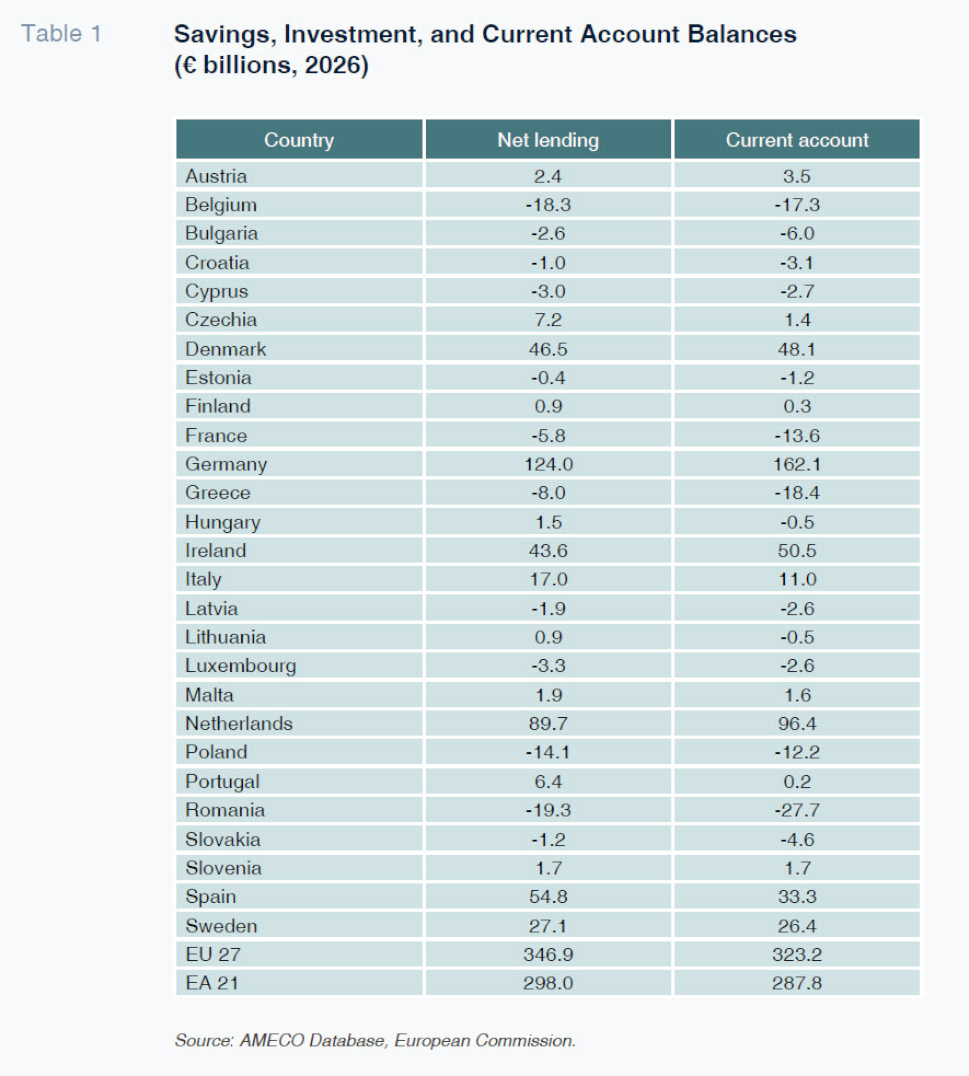
The bad news is that Europeans find it easier to invest that money abroad than to match it with investment opportunities in Europe. That is a part of the reason (in causal terms) that so many European economies run current account surpluses. In accounting terms, the two numbers should be the same: when savings exceed investment, exports exceed imports in the balance of payments. The EU’s current account surplus was just over €323 billion — with the remaining €24 billion representing wealth received by the EU on its capital account and exported again in the form of lending.
A savings and investment union fixes only part of the matching problem, by promising to use European savings more efficiently and so promising also to rebalance macroeconomic performance. The challenge is to make sure European savings are used efficiently to finance productive investment that will at the same time shore up European vulnerabilities. As the Letta, Draghi, and Niinistö reports acknowledge, achieving such a combination of goals at the same time cannot be left to the market. Market participants need to perceive the right incentives. Only an active European industrial policy used in tandem with trade policy instruments can provide the kind of insulation from world markets that Europeans require.
Agency
This more active role of European policymakers in shaping the incentives faced by market participants requires a clear understanding of the overall or strategic purpose underlying the savings and investment union. Capacity alone is not enough; the political willingness — or “agency” — to use that capacity is equally important. Moreover, the strategy underpinning that agency needs to be comprehensive. Shoring up European vulnerabilities is not enough. European policymakers have to imagine the economy of the future, they have to recognise the limits of what Europeans can achieve in isolation, and they have to prepare to protect any gains that are made from foreign interference and project European interests abroad. This agenda extends far beyond the single market. It involves more than a search for competitiveness. And it will only succeed if Europe can be made both more resilient and, when necessary, more assertive.
The many elements involved in any strategy for adapting to the changing geopolitical environment explain why the Letta, Draghi, and Niinistö reports need to be read alongside the White Paper for European Defence. Ideally, they would also be read alongside the EU’s economic security strategy and the collection of instruments that have been created to push back against economic coercion, strengthen investment screening, and accelerate industrial innovation (Bauerle Danzman and Meunier, 2024). The point here is not to rehearse the library of European documents. Rather, it is to highlight the three elements that unite them, which relate to research security, selective interdependence, and strategic enablers.
The concern for research security stems from the recognition that intellectual property rights and proprietary technologies represent sources of vulnerability both insofar as they can be used against European interests and because they can be misappropriated by non-Europeans. Here it is important to underscore that the technologies involved do not have to be at the frontier of scientific discovery. Productive innovation can take place by scaling new ideas to market and also by making them available for adaptation (Feldstein, 2026: 27-46).
When European Commission President Ursula von der Leyen gave her State of the Union speech, she argued that Europeans do not need to lead in the development of large language models or other forms of artificial intelligence. It would be enough for Europeans to lead in developing readily deployable applications that could be adapted to improve industrial processes and so make them more efficient [1]. Whether she is right in this assertion is worthy of debate. That she may be right — and that it should be debated — is more easily accepted. Within that debate, policymakers will necessarily consider the vulnerabilities associated with using frontier models developed in other countries and the security of any deployable applications both in terms of their function and as proprietary technology.
Such debates will take place in many contexts. As they evolve, policymakers will accumulate a list of technologies that Europeans cannot develop or apply on their own, without either inputs or cooperation from other countries. The challenge is to identify which partners can be trusted, to what extent, across a variety of different scenarios. The conditional nature of this trust explains the need for selective interdependence (Anghel, 2025).
To illustrate how, it is enough to think about the role of geography, politics, and relations with third parties. Relying on partners from regions prone to conflict or whose market access is potentially shut off is a risk that needs to be managed. This is the lesson coming from Iran’s closure of the Strait of Hormuz and the Houthis’ attempts to control the Bab al-Mandab Strait. The political risks come from partners who might try to exert leverage over the relationship like the United States and China or who might quickly abandon any relationship when confronted with such leverage. And the third-party risk comes when an otherwise trustworthy partner suddenly exposes European firms to a breach of security through their relationship with another country. This has been a concern when European countries or close partners have deployed 5G technology from Huawei, raising the risk that this technology might provide a back door for Chinese government interference.
If Europe is to protect against such threats, European firms will need to develop key assets for which the markets are limited or nearly limited to public procurement. Such strategic enablers include the technology required for secure communications, intelligence gathering, and analysis. They include the equipment necessary for pushing back against hybrid threats, countering violent incursions, and projecting force abroad. This equipment is made of software and hardware, with different components coming from different suppliers. It requires consistent maintenance and upgrading. And it blends elements that have a dual use in the commercial sector with those that are exclusive to their strategic purpose.
These strategic enablers bring the research security requirements together with the requirements for selective interdependence. That combination requires a delicate balance of trust and compensation, particularly for those elements which have an exclusive use. Governments involved in the production of these assets will want to ensure that firms are compensated, intellectual property rights are protected, and procurement costs are shared. This balance is challenging to strike even within the European Union. Deciding which of Europe’s allies can participate in joint development and procurement projects is also challenging, as is explaining why the consortia are different for one project than they are for another. Having a hegemonic power like the United States provide the bulk of these assets was easier than negotiating across a group of relatively more equal potential partners.
Here again, a savings and investment union can address at least part of the problem by increasing the financial resources available for policymakers to influence through their instruments and incentives. The ability to blend dual-use technologies with those that are of exclusive use also makes it possible to widen the consortia involved and redistribute the costs and benefits. Without a savings and investment union, the costs involved would be greater and the capacity to use incentives to reshape the pattern of investments made by market participants would be diminished. Worse, different European governments would face the same security imperatives with very different access to subsidies for industry or borrowing for public procurement. This point is stressed in the Draghi report as a threat to fragment Europe’s internal market in an area where market concentration is necessary for European success. When making that point, Draghi went even further to advocate an increase in common European borrowing (Draghi, 2024: 61-62).
Effectiveness
The changed geopolitical environment places enormous demands on European policymakers. It also places enormous demands on European institutions and European solidarity. Shoring up the vulnerabilities of the European economy is only part of the concern; laying the foundations for a more decisive and purposive European Union is also important. The savings and investment union can lubricate that process by bringing European savings back to Europe to finance necessary investments. Along the way, the savings and investment union can also create a context within which European policymakers are able to shape market dynamics in ways that will help to foster the ”right” or necessary investment in innovation, partnerships, and capabilities that the European Union currently lacks. This combination of factors does not ensure the success of the combined financial markets reform agenda. The political opposition to those reforms still exists, as does the inertia surrounding the reform process. But this geopolitical logic is different from the incentives for pursuing that reform agenda in the past. That is a reason for optimism.
The open question is whether European politicians are willing to embrace the opportunity that a savings and investment union represents. It is also whether they will be able to agree on how to use that opportunity should they manage to create it. This analysis is not to downplay the seriousness of that question. Rather, it is to suggest that the same geopolitical logic underpins the need for greater European agency as well as greater insulation from world market forces and the instrumentalization (or weaponisation) of European interdependence. European policymakers may not rise to the occasion. If they fail, all Europeans will face the consequences. Knowing that is a good reason to bet on their success.
Notes
References
ANGHEL, V. (2025). Why the EU Is a Geopolitical Power: Wartime Enlargement, Integration, and Reform. Journal of European Public Policy, 32(12), 2826-2885.
BAUERLE DANZMAN, S., and MEUNIER, S. (2024). The EU’s Geoeconomic Turn: From Policy Laggard to Institutional Innovator. Journal of Common Market Studies, 62(4), 1097–1115.
DEMARAIS, A. (2022). Backfire: How Sanctions Reshape the World Against U.S. Interests. New York: Columbia University Press.
DRAGHI, M. (2024). The Future of European Competitiveness, Part A. Brussels: European Commission. September.
ECONOMY, E. (2021). The World According to China. Cambridge: Polity.
EUROPEAN COMMISSION. (2025). White Paper for European Defence – Readiness 2030. Brussels: European Commission.
FELDSTEIN, S. (2026). Bytes and Bullets: Global Rivalries, Big Tech, and the New Shape of Modern Warfare. New York: St. Martin’s Press.
JONES, E. (2021). The Financial Consequences of Export-led Growth in Germany and Italy. German Politics, 30(3), 422-440.
JONES, E. (2024). A Global Perspective on Geopolitics and Economic Statecraft. In R. BALFOUR and S. ÜLGEN (eds.), Geopolitics and Economic Statecraft in the European Union (pp. 9-20). Washington, D.C.: Carnegie Endowment for International Peace.
LETTA, E. (2024). Much More than a Market: Speed, Security, Solidarity – Empowering the Single Market to Deliver a Sustainable Future and Prosperity for All EU Citizens. Brussels: European Council. April.
NIINISTÖ, S. (2024). Safer Together: Strengthening Europe’s Civilian and Military Preparedness and Readiness. Brussels: European Commission. October.
UNDERHILL, G., and JONES, E. (2023). Optimum Financial Areas: Retooling the Governance of Global Finance. The World Economy, 46(6), 1582-1608.
Erik Jones. Director of the Robert Schuman Centre for Advanced Studies at the European University Institute and Non-resident Scholar at Carnegie Europe